
How to become a better applicant in one week


Most of our advice helps you play the long game: deciding what to work on, finding a fellowship, or building a network from scratch.
This article is about right now — what you need to become a better applicant for the hundreds of handpicked roles on our job board, within the next week.
As a writer for 80,000 Hours, Coefficient Giving, and the Centre for Effective Altruism, I’ve worked on seven hiring rounds, read over a thousand resumes, and given personal career advice to roughly one hundred people.
I’m qualified to talk about three things:
What applicants do that makes me pay attention (or stop paying attention)
The habits of highly successful applicants, and which ones you can start today
The unusual hiring strategies of the organizations we recommend, and what to know before you interview
Today, I’ll cover the first two. (Three comes next week.)
Hiring is hard. Make yourself easy to hire.
Here’s what my previous hiring round was like:
Just under 800 people applied. I split the pile with a colleague, which gave me 400 resumes and 1200 short-answer questions to read.1
To get this done within the week, while also doing the rest of my job, I had to spend less than five minutes per person. And we only had time to grade a few dozen work tests, so we had to cut over 90% of the applicants. These numbers aren’t unusual for an open hiring round.

When I read a resume, I need a strong reason to say yes or any reason to say no.
The most common reasons I say no:
Something trips me up. You misread a question or seem unfamiliar with the organization. The resume has multiple typos or confusing sentences. I want to hire conscientious and interested people; in a giant applicant pool, even a small negative signal pushes me away.
Nothing sets you apart. None of the jobs you list are outstanding in a vacuum, and they don’t map very closely to the role.2 Your answers are fine, but generic (or worse, AI). You might be great, but I’m not seeing it. This accounts for most of my rejections — bland applications knock out more people than mistakes.
The most common reasons I say yes:
You have a strong referral. If you get referred by someone my colleagues or I know, that person is staking their credibility on you. Strong signal! If we don’t know them, it helps if they work on the same issues we do (like AI safety or biosecurity), so that we know they’ve recommended you with impact in mind.3
You show me something clear and memorable. After my 20th resume in two hours, they start to blend together. Great candidates don’t blend: something sets them apart, whether that’s especially relevant work experience, an interesting personal project, or a sharp answer that grabs my attention.4
How to become easier to hire
Make your resume more legible
Bad resumes frustrate me not because the candidates are bad, but because I know there are good candidates I’m missing. Make yourself hard to miss.
Within five minutes, I need evidence that you can do the job, care about the mission, and (extra credit) seem broadly capable.
To quote Alison Green, whose resume guide I highly recommend: “A resume is a marketing document, not an exhaustive account of everything you’ve ever done in life.” Every sentence should convey that you are good at a job-related skill, or achieved something noteworthy.5
Two lines from a resume I recently edited:
“Managed compliance documentation and kept all partners aligned.”
“Cut new client onboarding from 3 weeks to 5 days.”
The first is totally unhelpful, because anyone can “manage documentation.” Every line like that makes me less interested.
The second is good. It demonstrates organizational skill, and isn’t something anyone could have done — at the very least, the previous client manager didn’t.
As you write, think about your personal “elevator pitch.” If you had two sentences or 30 seconds to make someone interview you, what would you say? What stands out about your background or skill stack? What one thing do you want someone to remember when they talk to the hiring committee?6
Also, work hard to eliminate every typo and awkward sentence. Read the whole thing out loud to yourself, or ask a friend to do it (much better than silent reading). Run it through some LLMs to be safe. Don’t be the person who applies to 20 jobs with a missing word in the first line; I’ve been that person, and I did not get those interviews.
Sharpen your personal SEO
LinkedIn: Some jobs will ask for your LinkedIn over a resume, and it’s one of the first things people see when they search for you. Make your page nice, and use its nigh-infinite space to cover your most important work in more detail.
Personal websites: A personal site is even better than LinkedIn — more fun to read, easier to remember. If you have skills to show off, or work you can share,7 that’s reason enough to make a site.8
The best thing I can think: “Wow! I’d love to meet the person who [made that project, earned that praise, wrote that post, etc.].”
I rarely think “...the person who has that resume,” because resumes are boring. That’s why you should show me something else. Hyperlinks are water in the desert — let me spend a minute reading something besides bullet points on a crowded page!
If I’m on the fence about a resume, I’ll Google you to learn more. When I find an empty LinkedIn and no personal site, I’m left without a strong “yes”.
Collect micro-experience
The career transition paradox: you need experience to get hired, but you can’t get experience until someone hires you.
The solution: use part-time work or volunteering to get “micro-experience.” These positions are easier to get, but still help you build a portfolio and collect references.
In my first EA role, I helped run a small event: I drove cars, ordered food, and picked up trash. No special talent required, but I showed up on time and made a good impression. The leaders referred me to a different org that also needed help. Those two events gave me a dozen new contacts in less than two weeks of work, and the second org eventually hired me.
At the time, I’d spent the last 18 months tutoring and had zero technical skills. You may have more options than I did, and almost anyone will have some options.
What you can do this week: Check the EA Opportunities Board, which features hundreds of part-time roles, internships, volunteer requests, and funding applications. Our job board also has these. The boards don’t perfectly overlap, so use both!
Prepare to network
You can’t build a network in a week, but you can start the process.
In rough order of expected ROI, you might:
Reach out to one person. As someone who isn’t famous but writes a lot, I get roughly one message a month from someone who wants advice. It almost always makes my day. If you want to connect with someone you admire, don’t be shy. Just use Ben Kuhn’s advice and send a specific request. If you make a habit of doing this when you read a cool paper or watch an interesting talk, you’ll have a network before long — but you have to start by doing it once.
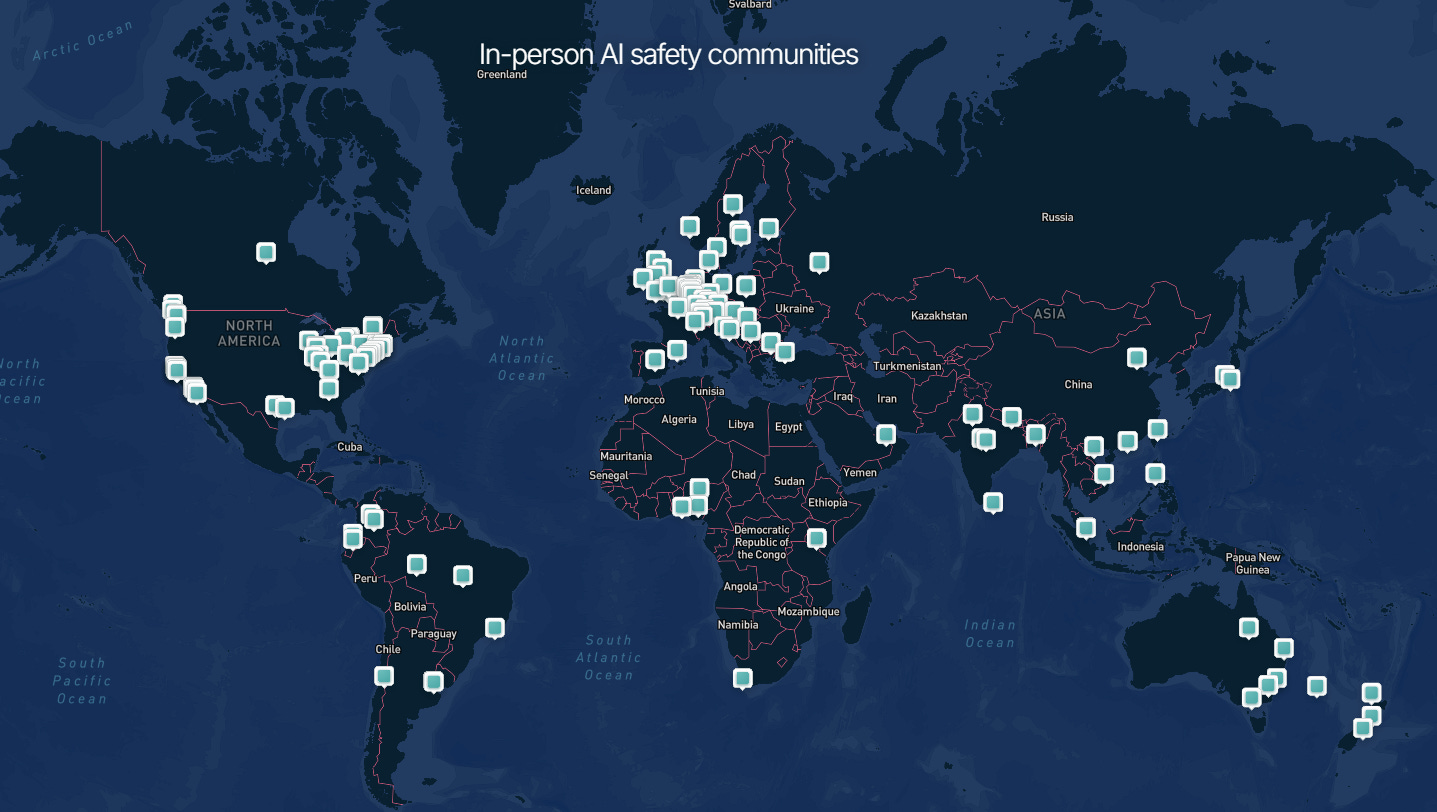
Plan your next event. Check AISafety.com, LessWrong, or the EA Forum for events in your chosen field. Most big conferences are built to encourage one-on-one meetings; you might walk away with 20 new contacts. In a couple of hours, you can scan all three sites, pick an event, and block off your calendar.
Refresh your LinkedIn. Connect with everyone you’ve met around the space. Then review where all your contacts, new and old, are working. People move around; you might find an acquaintance at your dream organization.9 If you have too many contacts, filter for those with relevant interests — for example, members of the 80,000 Hours group, or followers of orgs like IAPS or FAR.AI. Then, see step #1.
Make an open-source contribution. Look up AI safety orgs in Github, check relevant topics, or see the projects compiled by my colleague Sudhanshu.
Look for online groups. There are lots of AI safety-related Slack channels, Discord groups, and online forums. Join a few and introduce yourself! After that, look for ways to help others in the group, like giving feedback or sharing online resources. As B Cavello puts it: “Think through positive experiences you’ve had interacting with other people online and think of ways you can give more folks those types of experiences.”
Curate your information environment
For many jobs we recommend, ‘context’ is a key qualification — you’ll need solid fundamentals on AI safety or other topics to hit the ground running.10
You can’t build much context in a week. But you can put yourself in a position to see quality information on a regular basis:
Subscribe to newsletters and podcasts. We’ve collected some favorites here.
Follow relevant Twitter accounts. If you’re new to the platform, start with lists and cultivate your feed from there.11
Set a recurring reminder to visit websites without subscriptions (like LessWrong or the Alignment Forum — the EA Forum has its own newsletter).
For a one-time boost, see our 11 essential AI safety readings — you can finish them in a few days, and they cover the field’s most influential ideas.
Even if you understand your chosen field, a good information environment helps you sharpen your opinions. As you read, think about what makes sense to you, and where you land on current debates. The orgs on our job board want to understand how you think; generic interview answers have the same effect as a bland resume.
Learn from my mistakes
To get my first job, I followed almost all of this advice — very slowly. I went to multiple conferences with no agenda; I tweaked my resume for months before I gave it the full rewrite it needed; I ‘networked’ by arguing with strangers on Facebook.
It took me 18 months to get hired.
You probably won’t find a new job this week, but you can move much faster than I did. This week, set aside a few hours on a few evenings. Next week, do it again.
What to read next
Check out our revamped career guide — all our best ideas in one place! If you’re down to skip ahead, my favorite tactical advice is “How to network.”
Matt Beard, my work rival, wrote about getting into AI safety in 3 months. I didn’t write this post to one-up him — but if you liked it more, tell our boss 😉
Maja from Velvet Noise wrote an exemplary, example-filled post on using personal projects and obsessions to pique the interest of people who might hire you.
Gergő Gáspár wrote my favorite article on building AI safety context.
B Cavello wrote about finding work in AI policy: advice includes “be perceived” and “be the reply guy you want to see in the world.”
Some places use AI for this step now — but if you want to get hired, you’ll eventually need to impress a human reviewer.
To quote 80,000 Hours’ Nik Mastroddi:
“When I started recruiting staff myself, I realised that I’d made some big mistakes in how I previously approached applications. The biggest one was trying to make good prose and narrative out of a statement or cover letter instead of very explicitly addressing the selection criteria. “
“Once I was the one with the checklist, the deadline, and the huge pile of applications, I realised how little I prioritised ‘good writing’ like this in a cover letter. I wanted to know if a candidate met the criteria [...] and understood the requirements.”
Hiring is a huge gamble. Everyone tries to present their best self, but that doesn’t mean they’ll still be the same person after six months. I’ve worked with people who had solid backgrounds but left after a few weeks, constantly missed deadlines, or lied about something important. References don’t guarantee a good fit, but they make a bad fit less likely by showing that someone has the right basic abilities and some amount of patience.
I still remember Joy, who answered an open-ended question about improving CEA’s website with over a dozen good copyedits for our top-level pages. At that point, the resume no longer mattered.
I used this resume to apply for EA roles in early 2018. It isn’t perfect, but every line makes a clear statement. I emphasized a part-time job advising donors because that was relevant to the roles. For my other work, I tried to signal broad competence or productivity, like the number of people I reached or what people said about me. I cut my least interesting items, which let me use a bigger font and present something digestible.
I’ve hired multiple people who weren’t the most ‘impressive’ candidates in their round but did prove they could do the work I needed.
This doesn’t just have to be writing or code! Show me an event you organized, testimonials from happy clients, or a low-jargon summary of your scientific publications.
Personal websites I love: Sammy Cottrell, Andy Masley, and Jasmine Sun. They link to all their work on one page, and barely even make you scroll.
When I was a student journalist, the other journalists never talked about AI safety. But five years after I graduated, at least three of them were in that field.
I’ve seen a lot of Slack threads and Google Docs about job candidates; the single most common negative sentiment was “seems sharp, but isn’t familiar with AI safety.”
 | A guest post by
|
Thanks Aaron. I'm looking at a role change and this is super helpful. V useful to hear your thought process when reviewing candidates and personal experience as applicant :)
What if my resume is boring because I’m boring?