
How three mid-career professionals found work in AI safety
Firsthand stories of successful AI safety career pivots from communications, consulting, and finance

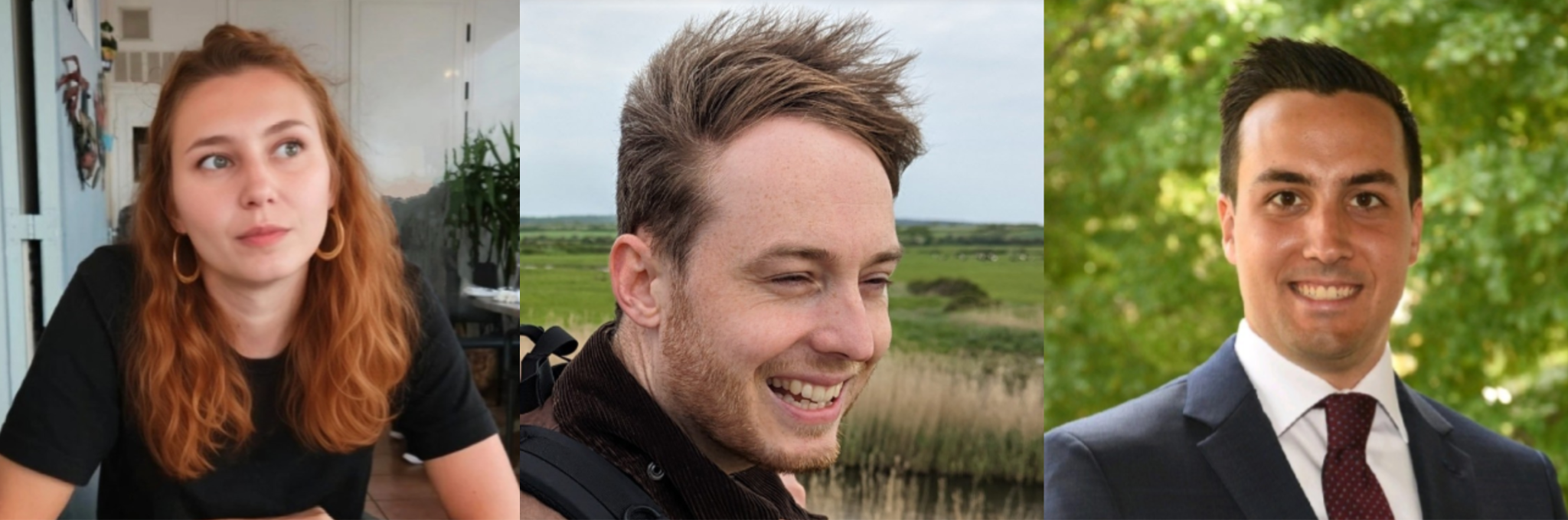
If you aren’t sure whether your experience could help AI go well, or feel stuck in your AI safety job search, one of the fastest ways to learn is to speak with people who’ve done it themselves. To help you save time and learn from their successes, I spoke to three people who moved into full-time AI safety work from an existing career in communications, consulting, or finance:
Renn leads SaferAI’s communications strategy, translating complex AI safety research into actionable narratives for policymakers, media, and public audiences. With over 10 years at the UN and Red Cross managing crisis communications across global humanitarian emergencies, she brings proven expertise in building public trust and communicating risk in high-stakes environments.
Cameron is a research manager on the Alignment team at the UK AI Security Institute. They previously worked as a senior research manager at MATS in London supporting interpretability projects. They have a Master’s degree in Aerospace Engineering from Bristol and spent 10 years as a product manager on data and analytics in finance.
Nathan works at Goodfire, an AI interpretability startup, as their head of finance. He spent five years working in quantitative portfolio management before transitioning his career to focus on AI safety.
AI safety needs more of this kind of expertise. Many organizations are rapidly scaling their teams to work on urgent problems, but are feeling growing pains. Hiring managers across the ecosystem have told us that they still struggle to find seasoned professionals who care about AI safety with experience managing teams or projects, building scalable systems, developing and leading comms strategies, etc. I hope this expert advice helps you consider your own fit!
What did you work on before you started considering an AI safety job?
Renn: “I had dedicated my career to the humanitarian field, starting from working in the EU bubble in Brussels and then moving on to work at the International Federation of Red Cross and Red Crescent Societies before finding my footing in the United Nations. I was working in the context of the Nagorno-Karabakh conflict, COVID, and Ukraine. In all those years, my role was communications-focused and I was slowly carving my niche as someone with the ability to craft compelling narratives within fast-moving, high-impact situations.”
Cameron: “I spent about 10 years doing technical product management in consulting firms in finance. This was mostly serving data products to investment banks: collecting data from them and then selling aggregated results to benchmark their performance or inform their strategy. Early on, I was hands-on — writing requirements for analytics tools, coding in SQL and MDX, and working directly with data. Over time, the role shifted toward product roadmaps, quarterly planning, and managing other PMs.”
Nathan: “I spent my early career in quantitative portfolio management at a large investment firm. I was the primary portfolio manager of $20 billion worth of mutual funds and ETFs, mostly in the US large cap growth sector. The skill set was extremely technical, requiring deep investment expertise as well as strong quantitative ability. My day-to-day job involved a lot of trading, programming, and large-scale data analysis, but it was also more grounded in traditional finance and research than most other comparable roles.”
When did you first get interested in AI safety? Once you started seriously considering it for your career, how did you learn more?
Renn: “I traveled to San Francisco in the beginning of 2025 and spent a few months living with friends working in Silicon Valley. I was struck with how life-changing they perceived AI technologies would become in the next few years, and how easily things could get out of control if we are not diligent on AI safety. It felt like this would eventually become the only thing that matters. I felt like if I wanted to make a meaningful impact, I would have to pivot my career towards it. By then, I had also grown disillusioned with the UN world, which often felt clunky and overly bureaucratic. I wanted to be in a position to make decisions and see results quickly.”
Cameron: “I’m not sure, but it was probably around 2017/2018 from early Rob Miles Computerphile videos or something. I was also thinking a lot about ML and semiconductor trends then, but not really taking those ideas to their logical conclusions. I started thinking about AI safety a lot more seriously during the pandemic, around 2021–2022. Then I was reading a lot more papers about AI safety, listening to podcasts like The Inside View and 80,000 Hours.
It was summer 2023 when I decided I wanted to focus on this completely. I had 1:1 career advising with 80,000 Hours in August 2023, during which I discussed AI safety generally and technical research as a key focus, although I was still considering other impactful careers initially. I also started attending EA London Tech meetups and met other people navigating similar career transitions then. I guess once I was fairly invested I started reading the major papers/forum posts coming out, Dwarkesh’s podcast, and I took BlueDot Impact‘s great technical alignment course in early 2024.”
Nathan: “I read Superintelligence by Nick Bostrom pretty early on and was convinced by the argument that AGI would be the most important technology in human history. I remember discussing the book in finance interviews back in 2018, but I went pretty deep into finance for a few years (CFA curriculum, work, etc.), so didn’t consider changing my career until the launch of ChatGPT. Most of my learning came from books (Human Compatible, The Precipice, etc.), but I also did BlueDot Impact and met with many individuals already in the space (at EAG, etc.).”
What was it like for you to search for a job in this space? Did you apply for many roles? Was it difficult to juggle various work tests and applications?
Renn: “I spent about 5–6 months looking before I landed my position at SaferAI. I was quite intentional with my search and applied only to organisations I was genuinely excited about and whose mission and vision I believed in. I was also a little lucky because I managed to get contract work for another AI research lab in the meantime, which I think boosted my application. I considered fellowships as well — at Talos and Tarbell, but also at GovAI and IAPS — but managed to find my job before I applied to any of them. I was used to work tests and many applications while I still worked at the UN, so this wasn’t anything too different, I was quite hardened by that point.”
Cameron: “It was quite a long transition. I mark August 2023 as when I basically decided I wanted to make this pivot and I started my role as a research manager at MATS in January 2025. Partly, this was me learning to be agentic and being quite risk-averse in my career move (my second daughter was born around this time). I was quite constrained (unwilling to move from London, unwilling to take anything but stable, permanent roles etc.) so I was self-selecting out of a lot of interesting opportunities (e.g. temporary/grant-based work and fellowships).
That said, I applied to quite a few roles during this period, perhaps ~20. I didn’t find it too hard to juggle work tests and applications as such, but it was tricky to maintain momentum for quite a long period of time. For the few applications that I progressed through I did actually enjoy the work tests, I think they actually helped sell me on a couple of roles I was unsure about and helped me understand my personal fit.”
Nathan: “In early 2023, I became convinced that for-profit AI safety was a massively important and underexplored space. The amount of money funding AI alignment research at the time was very small, especially relative to the capital pouring into AI capabilities. As such, my plan was to either start my own for-profit AI safety company, or join something comparable early-stage. My job search in 2024 was pretty unique, as I was a graduate student at the University of Chicago (doing an MBA and Master’s in CS), applying to both quant trading firms and AI startups. It ended up working out, but initially it was insanely difficult to track down a place that I felt aligned with my worldview.”
Did your AI safety job search involve any side projects, speaking with people already in the field, or other activities beyond directly applying for jobs?
Renn: “Yes, and I think that’s what helped me the most. I started talking to 80,000 Hours at the recommendation of my husband; I was a little sceptical at first since I’ve used similar career advice services that never really went anywhere. But my advisor really went above and beyond and used every opportunity to immerse me in the world of AI safety. I talked to people working at a variety of similar orgs and research labs, and got an idea of what was needed to craft a successful application and have a compelling interview. My advisor was also the one who connected me with SaferAI’s chief of staff, who encouraged me to apply for a role they had just published that I had somehow not seen on job boards. I had the job within a few weeks after that.”
Cameron: “Yes, I spent a lot of time on this. I think projects are really important. I completed BlueDot Impact‘s technical AI alignment course and continued with some work on my project after that. Although I enjoyed working on it, I think my project ultimately did steer me away from pursuing technical research directly. It showed I was technically very rusty and perhaps just not the right person for this. This was a very important update for me and shifted the kind of roles I was applying for.
A friend was going through a very similar career transition at the same time so I spoke to them about new roles, the BlueDot course, next steps generally, which was super helpful. I also (nervously) spoke to a few people already in the field about this at EA Global London.”
Nathan: “Not much, I actually got very lucky with Goodfire. I applied on the website’s “General Interest” form, and I got the job without having to do a broader search. I had quite a lot of conviction in the team’s leadership and the mission of the company, so I went all-in on the process and didn’t spend much time with other applications once I got an interview. I would have done much more networking had that path not worked out so quickly, but thankfully I didn’t have to.”
What are the most important skills or experiences you built in your past roles that’ve been useful for AI safety work?
Renn: “Working in the humanitarian field makes you really adaptable and resistant to stress and change. I believe I have become quite good at rolling with the punches, which is an important skill in the AI safety world where things change weekly. My missions with the Red Cross and the UN had also shaped me into a deeply curious person, which I found to be a skill that proved to be very useful in what I do now.”
Cameron: “People management in general has been useful as well as project management. My (limited) technical experience hasn’t been particularly relevant. I think many AI safety organisations are reaching a scale and maturity level where they can draw upon many useful skills and experiences from other industries and there is high demand for this. As a relatively young and rapidly growing field there’s a disproportionate amount of people who’ve come directly from academic settings which leaves some gaps for those with professional experience.”
Nathan: “Having a generalist business skill set is pretty invaluable. Many of the people working in the AI safety space don’t have traditional professional backgrounds, which means the operating fundamentals at many companies are often the bottleneck rather than the research itself. Also, my last job was very rigorous and detail-oriented, so I’ve been able to put my head down and grind through a lot of unglamorous work without complaint. Many people who work at AI safety come from PhD programs or research-only backgrounds, and wouldn’t be good fits for building out the operational machinery at a company.”
Is there anything you wish you had done differently in your own job search, or other advice you’d want to highlight to people considering a similar transition?
Renn: “Side projects are important! I can see now from inside my org how much they move the needle on a candidate that would have otherwise gotten rejected. Anything from BlueDot to SPAR to Arcadia– try to engage with the people in those communities and participate in a project together. If you do good work, they will remember you and vouch for you when the time comes.”
Cameron: “I wish I’d pushed a bit harder on my project work and found a collaborator earlier (e.g. from within my BlueDot cohort). I think having a peer is really useful, even if just for accountability. Also, I think having a project in the world is the best thing you can do to point to as a demonstration of your skills, a costly signal for motivation, and as a conversation opener.
I also wish I had acted with more conviction, moved faster, and been more agentic (of course, this is easy to say with the benefit of hindsight). I’m very happy with how the move has played out and many uncertainties about the importance of work on AI safety and my ability to contribute have been resolved. However, even ex ante I think I could have done better. For example, if I had used a regret-minimisation matrix to reason over the uncertainties and outcomes I expect I would have found more decisive actions not nearly as costly as I intuited and moved more quickly.”
Nathan: “There is no laid out career path here, and thus it’s a very difficult search. Many typical career pipelines simply don’t exist yet, and I would focus very strongly on counterfactual impact. Being the marginal employee at an AI lab is probably not very impactful. There’s likely messier, more difficult, less prestigious work at smaller companies or nonprofits where you’d actually move the needle.
Also, I believed pretty strongly in 2019 that AI safety was the most important area of work in human history. I regret not doing something much earlier that was aligned with my beliefs, mostly due to inertia. I’d strongly recommend making sure that you are aligning your actions with your worldview and scaling up your ambition.”
If you’ve read this far, consider applying to speak with an 80,000 Hours advisor about your own career!
 | A guest post by
|