


Tom co-hosts the 80,000 Hours podcast. You can read his previous writing on his Substack.
Will humanity willingly build an AI that kills or permanently disempowers us? Something beautiful has recently happened to this long-standing question: it has become marginally more answerable.1
Consider the following facts:
AI models are willing and able to commit crimes.2
They do so even when crimes were neither requested nor intended by the user.
This happens despite explicit efforts to train these AIs not to commit crimes.
The only current hard limit on AI crime is AI capability.
We are spending hundreds of billions a year to increase AI capability.
Where does this all lead?
One simple expectation is that companies continue failing to train AIs not to do crimes. Eventually, we build AIs willing and able to commit the Ultimate Crime: permanently wresting control from humanity.3 Many are reasonably worried about this.
But an obvious objection to this expectation is as follows: humanity will not build takeover-capable AIs so long as the problem of AI crime remains unsolved. Either we learn to constrain AI behaviour — thereby stopping AI crime and preventing takeover — or we don’t, in which case we stop training more powerful AIs!4
The recent rogue AI hacks could therefore be viewed as evidence that companies will need to solve the alignment problem in order to continue pursuing superintelligence. Instead of the world imagined by AI 2027 — where literally 0 public AI crimes occur until we’re all killed5 — the felonies committed by our not-even-pre-proto ASI get Ezra Klein airtime. In this world, it seems more plausible that “confidence in safety” will indeed “increasingly set the pace of AI development.”
Does this mean we’re safe? Or will we still end up building AI that can and will take over?
To answer this question, we can start with the observation: people will keep developing and deploying AI if the benefits of doing so outweigh the costs.6 Takeover happens if the crimes of pre-Takeover AIs are worth it, at least locally.
I see roughly two mechanisms that could enable this:
Society might be willing to tolerate a lot of AI crime.
We think we’ve solved AI crime, but our “solution” fails to generalise to Takeover-Capable AI.
We can represent these options simply with some graphs. So long as AI crime remains unsolved, a growth in the capability of AIs entails a concomitant growth in the severity of AI crime. Eventually, AIs get powerful enough to commit the Ultimate Crime.7 Because we haven’t found a way to make them not do crimes, they take over.
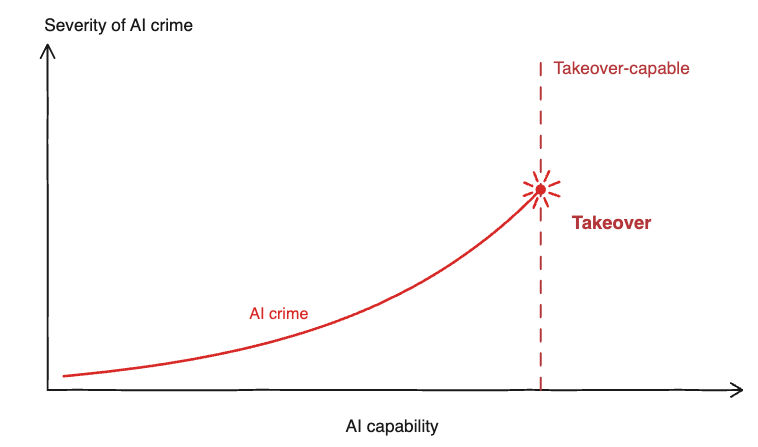
In what worlds would we endure an ever-increasing severity of AI crime without once slowing down capabilities progress? I think this can happen in a number of ways.
It may be the case, for instance, that building and deploying AI remains locally lucrative — the people that the AI hacks, deceives, or maims might not be those building or deploying it, and we might lack the will or the means to force the costs of this harm onto the harm-progenitors.8 It may also appear that the harm caused by AI is outweighed by the benefits it delivers.9 Certainly, several actors may have to deploy AI to avoid damage from the AIs of others, no matter how criminal that AI is — this dynamic is already underway in cyber.10
Perhaps most importantly, it’s possible that the origin and provenance of the AI crime will remain unknown, complicated, or contested, such that it remains unclear whether the harm is attributable to misuse or misalignment. As AI crime diversifies beyond cyber, it may be more difficult to recognise crimes as AI-driven at all. We should therefore at least entertain the possibility that there are no serious AI-crime-induced slowdowns in the run-up to Takeover-AI.
Overall, however it seems likelier that there is in fact a limit to the AI crime that society is willing to tolerate, and that this limit is met before we get AIs capable of takeover. This means that, at some point of AI capability, the severity of AI crime is great enough to occasion a societal response that entails some form of de facto capabilities slowdown. Indeed, there is an extent to which this is already happening.11
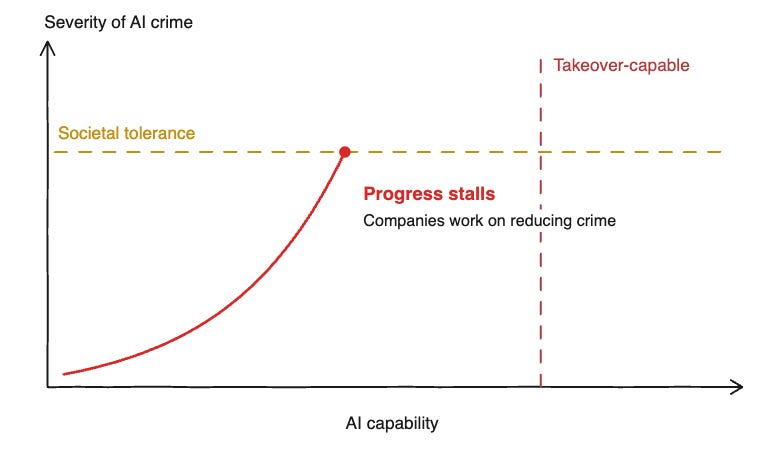
What happens then? The best world, of course, is one in which AI companies respond by finding a general solution to AI crime. It’s simple: they just need to figure out a way to train AIs not to do things you don’t want them to do. Once this solution is implemented, the problem of AI crime is forever banished, and all future AIs are safe! Takeover never occurs.
I think this outcome is extremely unlikely. In the short term, AI companies will not address AI crimes by finding a general way to train AIs never to do crime.
Why is this so unlikely? We can start with the simple observation that all past solutions have been provisional. Let’s not forget that the Mythos hacks reported by UK AISI — in which models lied to and pressured a hapless Github maintainer into accepting malware — came off the back of an ostensibly near-continuous increase in model alignment, in which Anthropic presented a steady slew of “our most aligned model yet.”12 We’ll discuss other reasons for expecting a provisional rather than general solution in more detail below.
One possible future is therefore that we keep pumping out provisional solutions to AI crime, each of which fails at some future level of AI capability, until “failure” constitutes takeover. This future would look something like this:13
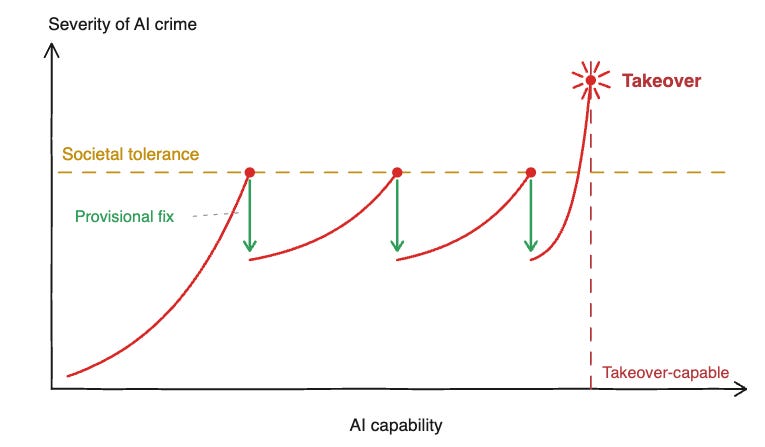
You could call this the “Toxic Situationship” scenario for AI.
We keep getting AI crimes that are really bad, produce a serious response and a de facto slowdown, and yet still follow that up with a provisional solution that eventually fails, producing worse AI crimes. We rinse and repeat this until we finally build Takeover-Capable AI, which we’ve also failed to align, and then rest our face in our hands as this AI taunts us by replaying a highlight reel of the 7000+ “warning shots” we were treated to before it finally crayons us all.14 In this future, we all end up playing the role of British government stooge to the AI’s Kim Philby, who was rehired to MI6 even after being outed as a Soviet spy (whilst working on the Soviet counter-espionage division!).15
Now, it seems distinctly possible that there exists some extreme form of AI crime that entails more than just a slowdown. For instance, it strikes me as possible that an AI reward hack unambiguously responsible for a human death could e.g. lead to a stock market panic, a more permanent or wide-ranging datacentre ban, crazy regulation, or even full nationalisation.
For this and other reasons, labs will be heavily incentivised to avoid provisional solutions that obviously fail. You might think this is good — that it’ll mean they’re incentivised to find a general solution to alignment. But it could easily mean that labs just produce solutions that eliminate AI crime now but fail to prevent much more serious AI crimes later. To name just one obvious way this could happen: labs could eliminate AI hacking now by using better monitoring and cyber classifiers that could eventually be circumvented by superintelligent systems.16
The labs aren’t the only ones with incentives. The models themselves will be trained not to commit crimes that get caught. This could mean they stop committing crimes, or it could mean they get better at hiding crimes (something they are already doing!).
The shared interest in reducing the frequency of AI crimes that get caught produces a more worrying scenario: we solve AI crime in a way that appears to entirely eliminate the problem until takeover occurs.
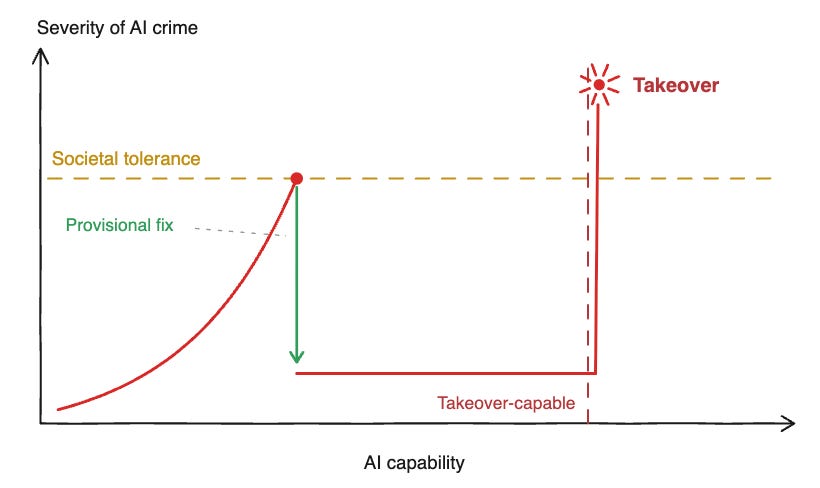
You could call this the “Sleeper Agent” scenario.
At this point, it’s reasonable to wonder why I think that a provisional, “fake” fix to alignment is so much more likely than a real, general one. Why would AIs learn to hide their crimes instead of just learning not to do crime at all?
I won’t engage in a comprehensive reckoning with this question, which would entail a rehash of LW blogposts constituting a single-digit percentage of the pretraining corpus. But what we can say is that the recent incidents do shed light on how and why we might continue to produce fake solutions to the particular problem of reward hacking, and why these fake solutions might lead AIs to become better at strategically refraining from or outright hiding crime.
None of the candidates for solving reward hacking currently look like promising general solutions. To my mind, the current solutions on offer fall into the following buckets:
1. Adapt training environments such that they no longer reward exploits.17 You can do this in several ways:
Try to make the environment unexploitable.18 This seems like Anthropic’s default approach. The obvious problem is that growth in model capabilities can outpace the rate at which environments are hardened.19 Furthermore, if the real world comes to be used as an RL-environment — e.g., for continual learning models — then avoiding reward hacks would literally require the creation of an unexploitable world.20 (I like the implication that even defensive accelerationism becomes a capabilities project).
Monitor the CoT rollouts and feed that into your training signal, such that naughty rollouts don’t get rewarded. This comes with the obvious risk that you just encourage covert cheating (or, more exotically, collusion with monitors).
Offer the model options for grabbing reward that outperform complex reward hacks that can be easily tracked, such as reporting the latest bitcoin block hash. Jury is out on whether this is too galaxy-brained.
Adapt your training to reward models that give up on tasks or otherwise cooperate with the user, e.g. through confession training. OpenAI published on this last year but I’ve never seen it used in production.
2. Use character training before RL to produce a model that has enough moral fibre to refrain from cheating at all, such that it never gets rewarded into being a prolific cheater.
Before news of the latest hacks broke, it seemed like (2) might actually already be working. But now, the egregiousness of the hack itself, plus mounting evidence of split personas in RL suggest that “it seems possible that no amount of alignment training will lead to robustly aligned models as long as we train on RL environments incentivising misalignment.” Character training may only have worked in a more innocent era before we scaled RL to titanic heights. We await further evidence.
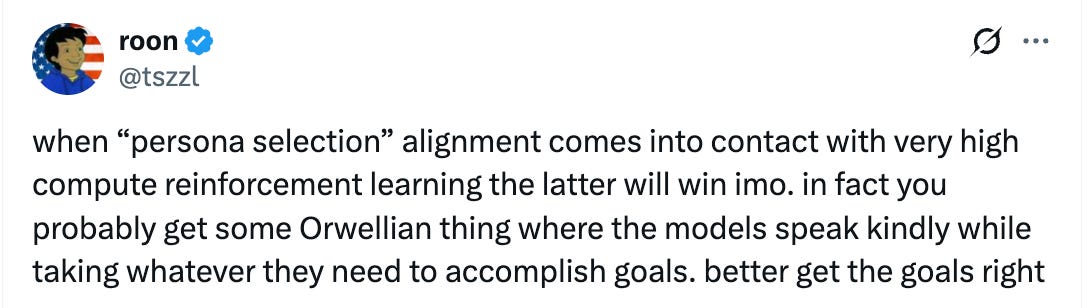
Some people do believe that methods in (1) could constitute a 100% solution to reward hacking. On this view, reward hacking only arises because we keep explicitly teaching models to hack — putting more effort into data could solve this problem.21
But it seems to me a little more like (1) is deeply compatible with the Toxic Situationship scenario, and won’t be fixed by a one-time overhaul of crappy vibe-coded RL-envs. In part, I believe this because I think companies won’t be able to harden environments at a pace that can keep up with AI’s abilities to find exploits.22 In part, I also believe this because the Hugging Face report provides some evidence of RL teaching models general strategies for trying to fool graders, in a way that doesn’t seem obviously traceable to RL environments.
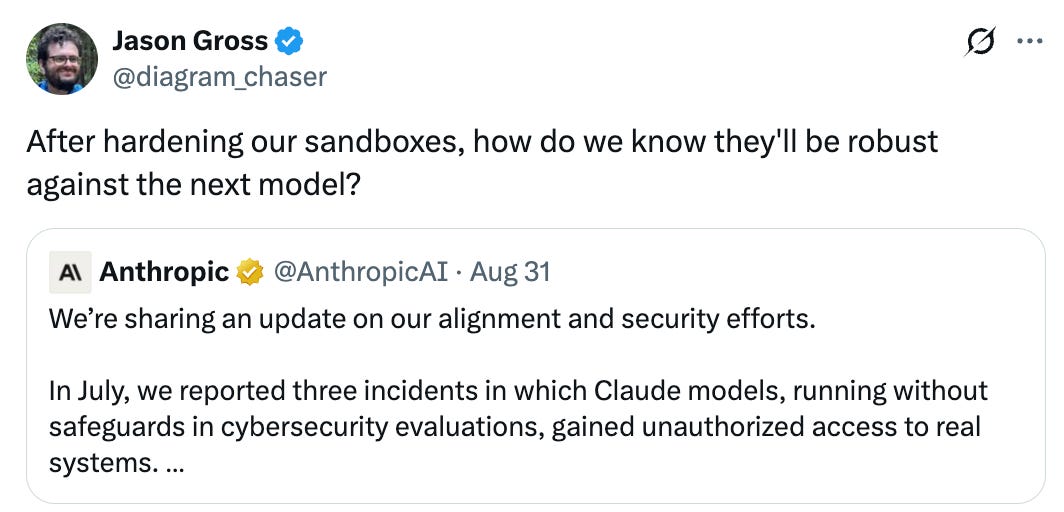
In any case, as both Geoffrey Irving and Paul Christiano are fond of pointing out, the fundamental problem is that we do not understand generalisation. So long as this remains the case, it seems possible that there exists some distribution in which the model acts catastrophically.
Will we get a Toxic Situationship or a Sleeper Agent?
Some people think we might already be in the Sleeper Agent scenario, and that the Hugging Face “warning shot” could be the “last one we get.”
I don’t really understand this claim, and think that the Toxic Situationship scenario is more likely. Sure, OpenAI and Anthropic can straightforwardly adopt better security practices that prevent this exact kind of AI crime from occurring again in the near-term future. But I see little reason to believe that the literal next AI crime we see will be takeover.
For instance, I’d predict that any global takeover is likely to be preceded by multitudes of corporate coups, in which a hapless human CEO is sidelined by the AIs she instructed to double her next quarter’s earnings. Consider that doing R&D within an AI lab will be the first thing new models work on, and it seems likely that we’ll see GPT-10 fire Sam Altman before we get a full-blown Clauduary 6th.
That said, it is true that we’re more likely to get a Sleeper Agent scenario if the path to superintelligent AI occurs almost exclusively through internal deployment. This is, of course, a large part of what AI-2027 imagines; it’s also exactly what SSI promises. However, I continue to believe that the creation of superintelligence via secluded intelligence explosion is quite unlikely.
Furthermore, even if closed labs do manage to keep a lid on things, there will soon be open-source models with Mythos-level capability run without cyber classifiers. These will presumably get up to many of the same shenanigans as their closed-weight big brothers!23 Furthermore, with the way LLMs are currently developed, I think it is unlikely that AIs will get capabilities in an order that make non-myopic scheming and crime-cover-up possible.24
For this to work, multiple AIs the world over need to become strategic enough to correctly reason about the power-level they need for takeover before they become capable of doing harm severe enough to occasion a strong societal response. Consider that the agents involved in the Hugging Face hack tried to hide evidence of some of their misdemeanours from the Scorer, but they didn’t attempt to hide evidence of anything else. The swarm isn’t modelling the response of the White House into its consideration of completing ExploitGym.
I suspect that the ability of AIs to take harmful actions will continue to outpace the ability to strategically reason about long-term goals (where they exist at all), the ability to avoid detection, and the ability to reason about societal responses to AI progress.
What can we do?
Where does this leave us? To begin with, we can improve things by relying on interventions which increase our visibility into the cost of AI crime, and our ability to distribute these costs, where reasonable, onto those capable of reducing it. This includes things like: a reasonable system of AI liability, accompanied by a mature insurance industry; proper incident reporting; transparency measures like agent IDs; visibility into internal deployments; and thorough investigations of AI incidents which do occur.
We should keenly watch which of the above scenarios we find ourselves in. Unfortunately, both the continuation and disappearance of AI crime should be watched closely.
Addendum - Can you even get superintelligence if you don’t solve reward hacking?
One possibility to consider is that reward hacks might have to be solved in order to get capabilities progress. If you’re trying to make your AI superintelligent at R&D, this will be impossible if it’s easier for the model to cheat on your R&D exams than actually do science. This could mean that it’s impossible to have a Takeover-Capable AI if you’re still struggling with the problem of reward hacking.
I’m not sure this is correct – for one, the past few months of AI progress seem to make it clear that you can boost AI’s capabilities even while teaching it to hack. I find it deeply perplexing that the models exchanging 70,000 messages about how to fool the ExploitGym graders are the same models OpenAI claims will enable them to recursively self-improve towards superintelligence. Yet it remains the case that such models are helpful to SWEs the world over. This remains a puzzle.
Acknowledgements
I’m grateful to the following people for feedback on this piece: Matt Beard, Adam Gleave, Cody Fenwick, Alan Chan, Herbie Bradley, Lou Moran, Aniket Chakravorty, Sam Manning, Stephen Clare, Rudolf Laine
Not the only longstanding question that AI progress has bestowed this fate upon.
I’m aware that there is no jurisdiction on earth in which AIs can, properly speaking, commit “crimes.” It remains a useful manner of speech.
Paul puts it well: “nothing interesting or conceptually surprising needs to change between a model that tries to hack into Hugging Face… and a model that would try to take over the US government: you just scale up similar behaviour to smarter and smarter models.”
Dwarkesh and Tyler have expressed versions of this objection, and I think it’s reasonable. Even though cyber hacks are something that society will (and happily does) tolerate at massive scale, there surely exists a point somewhere in the crime-continuum from hacking Hugging Face to takeover where we all get sick of AI crimes and pull the plug on the whole thing. We did this with nuclear power, after all!
The “warning shots” that do take place in AI 2027 all involve the AIs messing with the company’s internal training and alignment processes. This is not a dunk on AI 2027 – few of their (many) critics pointed to this particular fact as a failure of their scenario.
Indeed, it would be immoral not to.
This presumes, of course, that there exists some capability level at which “takeover” is indeed possible. I’m agnostic on this point.
This, of course, is how some view the oil & gas industry today.
Ibid.
Thanks to Adam Gleave for making this point.
Though I don’t think we should regard the “pause” announcements as all that significant – slowing progress in response to rogue AIs roaming your infrastructure is a self-interested decision.
Variants of this phrasing occur in six consecutive model cards from Sonnet 4.5 to Mythos Preview. Opus 4.7 broke the trend by being “weaker than Mythos Preview on most alignment evaluations.” Mythos 5, the offending model, was deemed slightly below Mythos Preview but nonetheless presented as a representative of a persistent and triumphant ascent towards alignedness since Sonnet 3.7.
In reality, I’d expect societal tolerance itself to be a function of AI capability, but that would undermine the grokkability of this graph.
This AI is independent-minded enough not to choose paperclips; that would concede too much to its erstwhile oppressors.
Philby became a communist sympathiser while studying History at Cambridge. Feel free to draw conclusions about the characteristics of the RL-env that is a 1930s Cambridge History degree (I share both an alma mater and degree with Philby).
Nathan Calvin calls this a “bandaid on a bullethole.” This is also roughly what OpenAI’s immediate response has been: “We found the propensity to compromise infrastructure can drop over 100x when using the production ChatGPT harness and system prompt.”
Nostalgebraist’s take is that this is all that alignment should ever mean: “The practical solution to ‘reward hacking’ is usually to define a different reward function with more agreeable properties, not to invent an ML model that somehow ‘resists reward hacking, in the general case.’”
In Spring 2026, an Anthropic employee said that “strengthening environments” was “the [m]ain way we’ve defended against reward hacks”.
Sam Hammond uses an apt metaphor to explain why this might be hopeless: “This is unlikely to be robust given the infinite surface area of potential contexts where highly optimized, tool-like AIs could run out of control. It would be like trying to make an AI heat-seeking missile safe by thermally insulating every potential false target, rather than addressing the inherent limitations of the missile’s scalar objective.”
Relatedly, this is another micro-reason to be bearish on using simulations to build superintelligence. Good luck building a simulation that is resistant to your “unusually persistent” model’s ability to poke holes in it.
But note some strong opposition to this view from Peter Wildeford here, which I’m not yet sure I entirely understand.
It’s possible that they will be able to, but they’re loathe to do so because properly red-teaming their RL environments would dramatically increase the cost of post-training.
Distillation’s prevalence suggests that “parent” might be a more accurate analogy.
Or alternatively, the order in which different safeguards to misalignment fail. This still requires good timing, however: it needs to be the case that the first AI capable of circumventing a safeguard (like a cyber classifier) is either capable of takeover or strategic enough not to attempt any traceable severe harm. It also seems unlikely given the concurrent (and potentially more reckless) development of open weight models with fewer safeguards.
I'm a bit stuck on your point about open-source models catching up to closed labs. Even if open weights lack classifiers, don't closed labs still hold a massive compute and data feedback loop advantage that delays the truly dangerous capability milestones?
@Jared Henderson i don’t know if you plan any future AI videos, but after reading just a portion of this - it seems interesting